



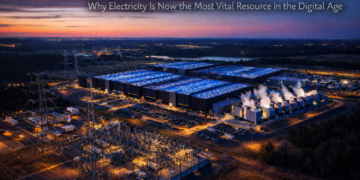

Across global markets, energy is shifting from a background utility to a strategic constraint.
For decades, companies assumed that if they secured land, permits, and financing, power would follow. That assumption no longer holds. Grid congestion, aging infrastructure, interconnection delays, and rising peak demand are reshaping how businesses think about expansion.
The result is a quiet but significant transition: energy is moving from an operational cost to a core strategic variable.
Grid Constraints Are Reshaping Investment Decisions
In many regions, utility interconnection timelines now stretch multiple years. Transformer lead times are extending. Substation capacity is limited. Power density requirements are rising, particularly in data centers, advanced manufacturing, logistics hubs, and electrified industrial operations.
This shift is not temporary.
Artificial intelligence workloads, electrification of transport, building decarbonization mandates, and industrial automation are driving structural increases in electricity demand. Meanwhile, transmission infrastructure expansion has not kept pace.
For businesses planning large-scale facilities, energy availability is increasingly the gating factor.
Site selection is no longer just about real estate and labor access. It is about grid access and long-term reliability.
From Backup Power to Strategic Energy Infrastructure
Traditionally, on-site generation and battery systems were installed for emergency backup.
Today, that model is evolving.
Behind-the-meter solar, battery storage, hybrid microgrids, and flexible demand strategies are being deployed not only for resilience but also for:
• Capacity assurance
• Cost predictability
• Peak shaving and demand charge management
• Carbon reduction targets
• Energy independence
Battery storage, in particular, has moved from a contingency tool to a financial instrument. It allows operators to manage load volatility, mitigate tariff risk, and maintain continuity in increasingly stressed grids.
In sectors such as data infrastructure and advanced logistics, uptime is directly tied to revenue. Even short disruptions can have disproportionate economic impact. That reality is accelerating investment in on-site energy systems that operate in parallel with the grid rather than relying solely on it.
The Rise of Long-Term Energy Partnerships
As projects become more complex, capital allocation becomes more selective.
Many operators are reluctant to divert capital from core operations into energy infrastructure. At the same time, the strategic importance of energy is rising.
This tension is driving new partnership models.
Energy developers are increasingly structuring “fund-build-operate” agreements, where they finance and manage on-site systems over long-term contracts. These arrangements reduce upfront capital burden while providing predictable energy pricing and operational accountability.
Pacifico Energy, for example, works with commercial and industrial customers to deploy fully funded on-site solar and battery storage systems under long-term service agreements. The model aligns incentives: the developer focuses on uptime and performance, while the customer gains resilience and cost stability without owning the asset.
This shift reflects a broader trend. Energy is becoming infrastructure-as-a-service.
Sustainability Reporting Is Raising the Bar
At the same time, regulatory and investor pressure around emissions disclosure is intensifying.
Scope 2 reporting, carbon accounting transparency, and science-based targets are no longer optional for many enterprises. Energy procurement strategies must now satisfy financial, operational, and environmental criteria simultaneously.
On-site renewable generation paired with storage can contribute meaningfully to decarbonization targets. But implementation must balance intermittency, reliability standards, and lifecycle economics.
In mission-critical environments, sustainability initiatives cannot compromise uptime.
The most successful projects integrate decarbonization with resilience — not one at the expense of the other.
Complexity Is Increasing — So Is Opportunity
The global energy transition is often framed in terms of generation capacity. But at the commercial level, the story is more nuanced.
It is about:
Reliability in constrained grids
Flexible load management
Capital efficiency
Lifecycle cost modeling
Operational risk mitigation
Companies that treat energy as a strategic asset rather than a commodity are gaining a competitive advantage.
This is particularly evident in energy-intensive sectors where expansion timelines now depend as much on megawatts secured as square meters built.
A Structural Shift, Not a Temporary Cycle
Energy volatility, regulatory change, electrification, and digital infrastructure growth are converging forces. Together, they are redefining how businesses approach power.
The old assumption — that utilities will always meet incremental demand on predictable timelines — is weakening in many markets.
In its place is a more distributed, partnership-driven model.
On-site generation. Battery storage. Hybrid microgrids. Long-term service agreements.
These tools are not replacing the grid. They are reinforcing it.
For businesses navigating expansion in constrained markets, energy strategy is no longer an afterthought.
It is central to growth.