




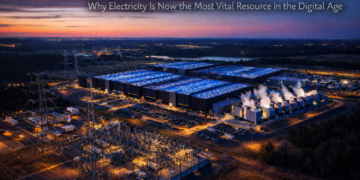
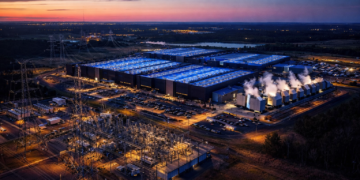
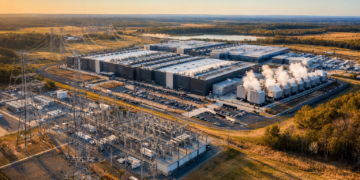

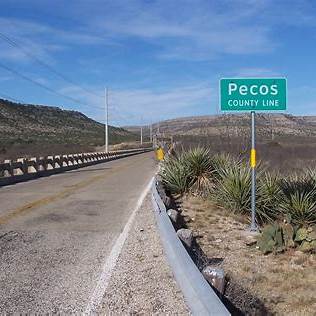
Pacifico Energy says it has cleared a major regulatory hurdle for GW Ranch, its private-grid power generation campus in Pecos County, West Texas—built specifically to serve hyperscale data centers and the growing electricity demands of AI. The company announced it has received a Texas Commission on Environmental Quality (TCEQ) air permit covering 7.65 gigawatts (GW) of gas-fired generation, which Pacifico describes as the largest such permit granted in the United States.
The permit authorizes construction and operation under state and federal air-quality rules, and effectively signals that Pacifico’s emissions-control approach has passed a key regulatory test.
Why this permit matters (beyond the headline GW number)
The AI boom isn’t bottlenecked by chips anymore—it’s bottlenecked by power, interconnection queues, and grid constraints. Recent analysis cited by BloombergNEF outlets puts a number on it: U.S. data center power demand could reach 106 GW by 2035, a sharp upward revision compared with earlier forecasts.
That demand is slamming into a reality the power sector knows too well: large-load interconnections can be slow, transmission takes years, and reliability expectations for data centers are ruthless (downtime costs real money and reputations). Against that backdrop, projects offering “grid-independent” or “private-grid” power have become the new land rush. GW Ranch is Pacifico’s bet that speed and certainty win.
What Pacifico is building at GW Ranch
Pacifico positions GW Ranch as a “power-for-data-centers” campus—a dedicated energy platform rather than a conventional merchant power plant feeding the public grid. According to the company, the site is designed as a hybrid system:
- 7.65 GW total permitted gas-fired generation
- 1.8 GW of battery energy storage
- 750 MWac of solar
- >99.99% availability target
- 8,000+ acres build-ready, with room to expand
- Multiple gas supply laterals, including a ~15-mile pipeline with up to 1 Bcf/d access to Waha (per company materials)
Pacifico says Phase 1 is sized at 1 GW, targeting first power in H1 2027.
The company pitch: “AI growth without sticking ratepayers with the bill”
Pacifico frames GW Ranch as a response to a problem regulators and consumer advocates are increasingly vocal about: big loads can drive grid upgrades and generation additions that may raise costs for everyone else.
Their proposed workaround is simple in concept: if the data centers don’t pull from the public grid, they don’t force grid expansion for their benefit—so the project “protects ratepayers,” in Pacifico’s words.
That argument is gaining traction nationally as utilities and regulators debate who pays when data centers arrive at multi-gigawatt scale. (Georgia, for example, has been wrestling with the scale of new generation needed to meet data-center-driven growth.)
What Pacifico leadership said
Pacifico CEO Nate Franklin called the permit a “precedent-setting milestone,” emphasizing the combination of scale and regulatory certainty that large-load customers want.
Constantyn Gieskes, VP of Project Development, said the approval “clears a critical path” and cited “turbines secured” and site delineations complete, while reiterating the H1 2027 first-power target and a scaling pathway beyond 5 GW.
The sustainability tension: hybrid design, but still gas-heavy
From an environmental lens, GW Ranch sits right in the messy middle of the energy transition:
- Pro: Adding solar + storage can reduce fuel burn at the margins, firm renewable output, and help manage ramps—especially if the operating strategy uses batteries for fast response and peak-shaving.
- Pro: A modern permitted facility with defined emissions controls is meaningfully different than an uncontrolled patchwork of temporary generators. The TCEQ air permitting process is specifically built around air-quality compliance and emissions limitations.
- Con: The headline capacity is still gas-fired. If fully utilized, a project of this magnitude has real climate implications unless paired with aggressive efficiency, high utilization of the hybrid components, offsets, carbon capture, or future fuel shifts—none of which are detailed in the announcement beyond “emissions-control strategy.”
In other words: it’s a “less bad” way to meet explosive demand compared with a disorderly scramble—but it’s not the same thing as a clean-energy-only buildout. The real-world impact will depend heavily on how the plant is dispatched, the extent batteries displace gas generation, and whether the project evolves over time.
Part of a bigger trend: “bring-your-own-power” campuses
GW Ranch is also a signal that energy infrastructure is becoming a front-end constraint for AI and data center development. Analysts are increasingly describing a shift toward on-site or near-site generation to bypass interconnection delays and grid congestion. BloombergNEF has highlighted how quickly load expectations are changing as projects scale up.
Whether this trend ultimately helps or hurts decarbonization depends on what gets built. The optimistic version: private grids become proving grounds for high-availability hybrid systems and accelerate investment in storage. The pessimistic version: it locks in new fossil generation at scale.
What to watch next
- Construction progress and procurement execution. “Permitted” is not “operating.” The next proof point is breaking ground and hitting commissioning milestones.
- Operating strategy transparency. How much will batteries and solar actually displace gas generation in practice?
- Community and resource impacts. Large campuses raise local questions (land use, air quality, water, workforce, and infrastructure).
- Customer commitments. Hyperscale demand is real, but the commercial story will be clearer once major offtakers are announced.
Bottom line: Pacifico Energy’s 7.65 GW TCEQ air permit is a serious milestone for GW Ranch—one that gives the project a level of regulatory certainty that matters a lot in the current race to power AI infrastructure. The bigger story is what it represents: the rapid rise of private-grid power campuses as the data center market runs headfirst into grid limits.