







Hawaii is one of the most unique power markets in the United States.
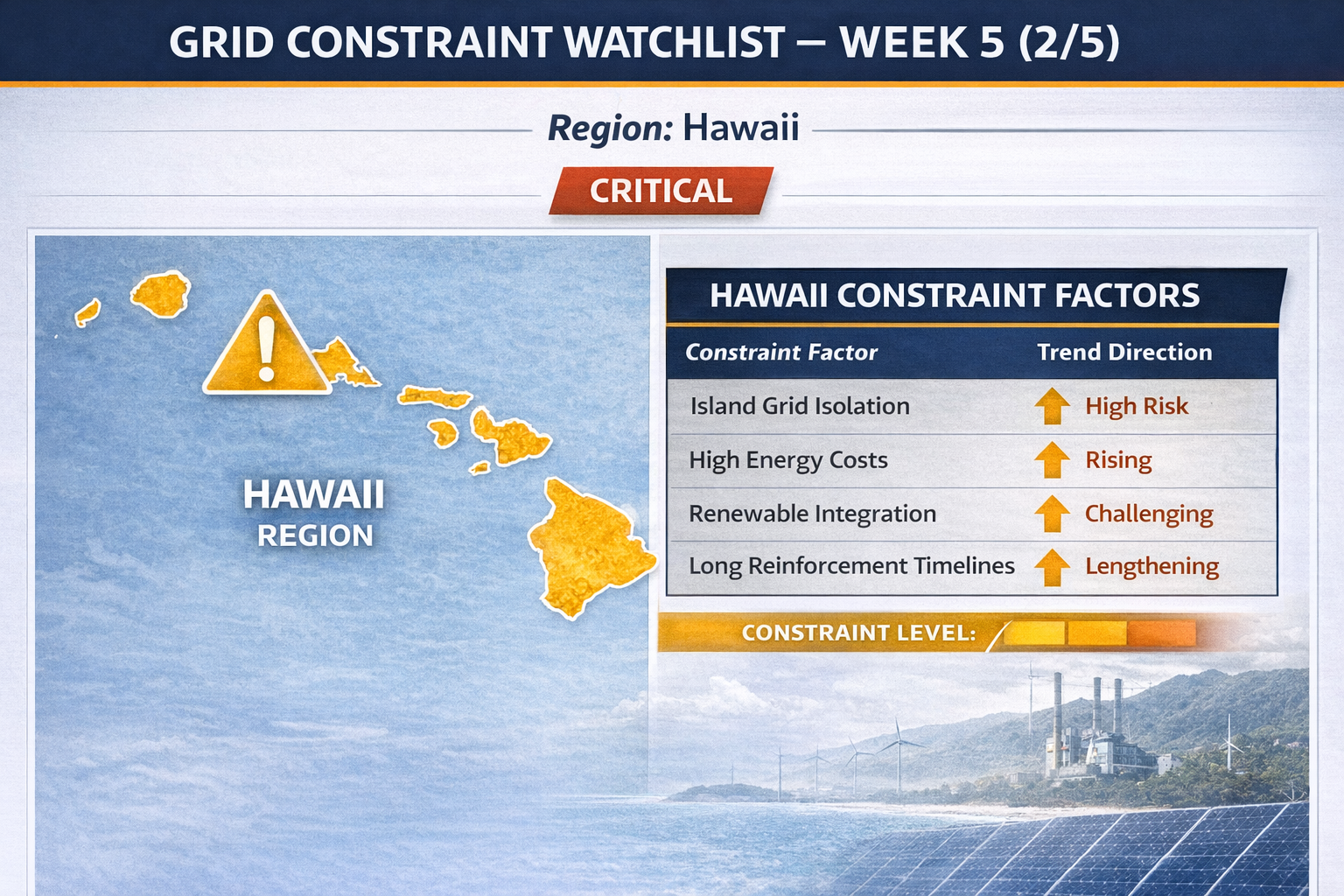
Unlike the mainland ISOs, Hawaii operates as an isolated island grid. There is no ability to import power from neighboring states. There is limited redundancy. Infrastructure decisions carry outsized impact because the system has very little margin for error.
At the same time, Hawaii is pursuing some of the most aggressive clean energy targets in the country, while also facing high energy costs and growing resilience needs.
This combination makes Hawaii structurally constrained by design.
Why Hawaii’s Grid Is Different
Hawaii’s constraint story begins with geography.
Island grids do not have the flexibility of interconnected continental systems. When demand rises or assets fail, the system cannot lean on neighboring regions for support.
In addition, Hawaii faces three overlapping challenges.
First, energy costs remain among the highest in the United States. Fuel logistics, infrastructure scale, and supply constraints all contribute.
Second, renewable integration is accelerating. Solar adoption is high, and storage deployment is increasing. However, managing variability on an isolated system requires careful balancing and firm capacity planning.
Third, infrastructure upgrades take longer and cost more. Equipment shipping, limited local redundancy, and permitting complexity can extend timelines materially.
As a result, large-load development in Hawaii requires early energy strategy alignment.
A Market Signal Worth Watching
Recently, a commercial-scale project evaluating expansion in Hawaii discovered that local feeder capacity and upstream reinforcement needs significantly affected the timing and cost of service upgrades.
The issue was not demand.
It was system tightness and limited flexibility.
That is a recurring dynamic in island grids.
Resilience Is Not Optional in Hawaii
In many mainland markets, resilience is a secondary consideration.
In Hawaii, it is central.
Operators must plan around:
• Limited reserve margins
• Weather-driven disruption risk
• High dependency on local infrastructure
• Tight delivery constraints for major upgrades
• The need for controlled onsite capacity
For many projects, hybrid architectures — storage, onsite generation, microgrid-ready systems — become part of the baseline feasibility discussion.
Not as an add-on.
As a requirement.
What This Means for Hawaii Projects
Hawaii remains a critical market for tourism infrastructure, defense operations, commercial development, and island-scale electrification.
However, power delivery is structurally constrained, and project timelines depend heavily on early coordination with utilities and realistic infrastructure planning.
Organizations evaluating load additions in Hawaii benefit from early analysis of:
• Local capacity limitations
• Upgrade sequencing
• Resilience requirements
• Hybrid and onsite flexibility options
Hawaii is not simply a “small version” of a mainland market.
It is its own grid category.
Author Note
The Grid Constraint Watchlist tracks power delivery dynamics across major U.S. markets as industrial and electrified load expands.
If you are evaluating a Hawaii project or navigating island-grid constraints directly, you are welcome to connect:
Phil Morgan
phil@pacificoenergy.com
www.pacificoenergy.com
a