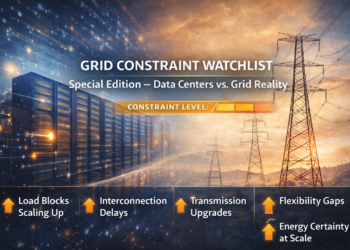



Across the United States, electricity demand is entering a new phase of growth. Data centers, electrification of transportation, reshoring of manufacturing, and rapid economic expansion are putting unprecedented pressure on the power grid.
For high-energy users—especially manufacturers—electricity is no longer just a utility expense. It is becoming a strategic input that directly affects operational stability, cost predictability, and long-term competitiveness.
Yet despite rapid innovation in energy technologies, many large industrial facilities have not moved aggressively to manage their power supply using either behind-the-meter or front-of-the-meter solutions.
Understanding why requires looking at how energy systems actually function.
Behind-the-meter (BTM) energy refers to power technologies located on the customer’s side of the utility meter. These include onsite solar generation, battery storage systems, microgrids, combined heat and power systems, and advanced energy management software. These assets allow facilities to generate electricity, store it, or strategically manage consumption directly within their operations.
Front-of-the-meter (FTM) infrastructure, by contrast, refers to large-scale power generation and grid assets connected before electricity reaches the customer meter. These include utility-scale solar and wind farms, natural gas plants, hydroelectric systems, grid-scale battery storage, and transmission infrastructure.
Both play distinct roles in modern energy systems.
Front-of-the-meter generation provides the bulk electricity that powers regions and supports grid reliability. Behind-the-meter systems give individual facilities greater control over energy costs, resilience, and operational flexibility.
In theory, the combination of both approaches should create a more efficient and resilient energy ecosystem.
In practice, adoption among high-energy manufacturers has been uneven.
Several structural factors explain the hesitation.
First, energy strategy is rarely viewed as a core operational priority. Most manufacturers focus on production efficiency, supply chains, and capital investment in equipment or facilities that directly increase output. Energy procurement is often treated as a routine expense rather than a strategic lever.
Second, capital allocation plays a major role. Even when onsite energy systems offer long-term financial benefits, leadership teams often prioritize investments that expand production capacity rather than infrastructure that reduces operating costs.
Third, complexity remains a barrier. Energy markets involve regulatory frameworks, interconnection requirements, financing models, engineering considerations, and utility coordination. Without specialized expertise, evaluating projects can feel daunting.
Fourth, electricity prices in many regions were relatively stable for decades. That historical stability discouraged proactive energy planning.
However, several emerging trends are beginning to challenge that assumption.
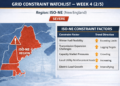
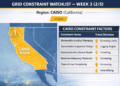
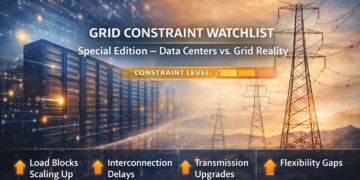
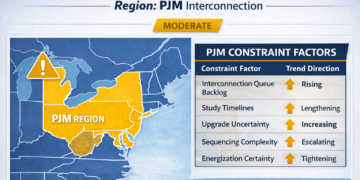
Grid congestion, transmission constraints, rising peak demand, and the rapid expansion of energy-intensive technologies are creating new pressures on electricity markets. At the same time, battery storage costs have declined dramatically, software-driven energy management systems have improved operational control, and federal incentives have expanded opportunities for investment.
As a result, the traditional model—where manufacturers simply purchase electricity from the grid without actively managing energy supply—is beginning to evolve.
Facilities that integrate both front-of-the-meter and behind-the-meter strategies are increasingly able to stabilize operating costs, manage demand charges, improve reliability, and hedge against future price volatility.
For industries with large and continuous energy loads—chemicals, metals, food processing, logistics hubs, semiconductor manufacturing, and advanced materials—electricity is becoming a critical operational variable rather than a background expense.
The companies that recognize this shift early may gain a competitive advantage not only in cost management, but also in resilience and long-term operational planning.
As electricity demand continues to grow across the United States, the role of energy strategy within industrial operations is likely to expand.
The question for many manufacturers is no longer whether energy systems will evolve.
It is how quickly their organizations are prepared to adapt.