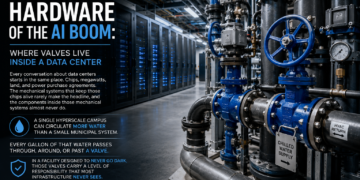





Most of the public argument about data centers and water happens at city council meetings, in permit hearings, and in headlines about drought.
The decisions that actually determine how much water a campus consumes over the next twenty years happen somewhere much quieter. They happen in a set of mechanical drawings, in a Division 22 and 23 specification, months before anybody moves dirt.
By the time a facility is running, the water story is mostly already written.
I spend my weeks talking to MEP engineers, mechanical contractors, and owners about cooling loops on data center projects. What follows is what I keep seeing — and where I think the industry still has real room to get better.
Where the water actually goes
Almost none of a data center’s water goes to people. It goes to heat rejection.
A campus running evaporative cooling or a hybrid cooling tower plant is turning water into vapor on purpose, because evaporation is a spectacularly efficient way to shed heat. The rough rule of thumb you’ll hear in the field is something on the order of 25,000 gallons a day per megawatt of IT load on a water-cooled design. Multiply that by a 100 MW campus and you understand why the neighbors show up to the hearing.
Then there’s the part nobody budgeted for emotionally: the shift to liquid cooling.
AI racks at 80, 100, 130 kW and climbing can’t be air-cooled at any reasonable cost. Direct-to-chip and rear-door heat exchangers are moving fluid to within inches of the most expensive silicon on the property. The good news is those are closed loops with low makeup demand. The complicated news is that the consequence profile of a leak just changed completely.
Water in the white space used to be a facilities inconvenience. Now it’s an uptime event with eight-figure hardware exposure.
Detection: stop treating it as a floor-level afterthought
Leak detection on a lot of projects still gets specified the way it did in 2015. Rope sensor around the CRAH units, a zone panel, a dry contact to the BMS, done.
That’s no longer proportionate to the risk. What good design looks like now:
Detection at the fitting, not just the floor. By the time water reaches a floor sensor, it has already traveled. Sensing at CDUs, manifolds, quick-disconnects, and above-rack piping catches events while they’re still drips.
Sensors that report a location, not just an alarm. “Zone 4 is wet” costs you fifteen minutes of hunting. Addressable sensing that tells you which run is wet costs you fifteen seconds.
Rate-of-change intelligence upstream. A pressure decay or a slow drift in makeup water is a leak announcing itself days before anything drips. Most plants have the instrumentation to see this and no logic configured to act on it.
A tested response sequence. Detection that pages a human at 2 a.m. is not a control strategy. Detection that isolates the affected branch, holds the rest of the loop up, and then pages a human is a control strategy. That sequence has to be written into the spec, wired into the BMS, and commissioned — not assumed.
Monitoring: you can’t reduce what you never submetered
WUE is the metric everyone quotes and very few facilities can actually calculate at loop level.
Campus-level makeup water metering tells you that you used a lot of water. It doesn’t tell you where, and it can’t tell you whether last month’s increase came from load growth, a drifting tower, a stuck float, a fouled heat exchanger, or a leak.
The plants that get genuinely good at water stewardship tend to have three things in common:
- Submetering by loop and by function — makeup, blowdown, condensate recovery, and each mechanical system separately.
- Water chemistry as a live signal, not a monthly lab visit. Conductivity and cycles of concentration drive blowdown volume, and blowdown is often the single most recoverable gallon on the site.
- Trending against IT load, not against the calendar. Gallons per kWh, tracked daily. The moment your water curve and your load curve stop moving together, something is wrong — and you found it in days instead of at the quarterly review.
Condensate recovery, reclaimed and non-potable supply, and thermal-hydraulic design that raises approach temperatures all belong in this conversation too. So does the honest tradeoff: air-cooled and zero-water-day designs save gallons and spend kilowatts. That tradeoff should be a deliberate engineering decision documented in the basis of design, not something discovered in year three.
Valves: the least glamorous layer, and the one that decides the outcome
Here’s the part I’ll admit I’m biased toward, because it’s what I do for a living.
Detection tells you there’s a problem. Monitoring tells you it’s getting worse. Valves are the only thing on the site that actually stops it.
And valves are, consistently, the most under-specified line item on the mechanical schedule. They get value-engineered late, substituted at submittal, and selected on price per unit rather than on what they cost you the one night they matter.
A few things worth putting real thought into while the design is still open:
Isolation granularity. How much of the plant has to come down to service one branch? If the answer is “a hall,” the isolation strategy is wrong. Sectional isolation costs a modest amount of steel and buys you maintenance under load for the life of the building.
Bubble-tight shutoff where it counts. “Drip-tight” is fine on a cooling tower fill line. It is not fine on a branch feeding a liquid-cooled row. Seat design, seat material, and pressure class should be selected against the actual differential and the actual consequence — not inherited from a standard commercial HVAC detail.
Actuation and fail position. Automated isolation is what turns leak detection into leak prevention. Every automated valve in the loop needs a defined fail position and a documented reason for it. Fail-closed protects hardware. Fail-in-place protects thermal continuity. Getting that decision backwards is discovered exactly once.
Serviceability without a shutdown. Can it be repacked, reseated, or actuator-swapped in place? On a facility with no maintenance window, a valve you can’t service in place isn’t really redundant.
Cycle life and temperature range that reflect reality. Loops that used to sit static now modulate constantly as liquid cooling chases variable AI load. A valve rated for occasional isolation duty is not the same valve as one rated for continuous modulation and thousands of cycles a year.
Standards and traceability. Materials certification, testing documentation, and manufacturer support twenty years out matter more on a facility with a thirty-year life than the delta on the bid sheet ever will.
Why this is a sustainability story, not a plumbing story
Water is becoming the constraint that decides where data centers get built, not just how they operate.
Communities in Arizona, Texas, Virginia, Georgia, and half a dozen other markets are asking harder questions and getting more sophisticated answers. Permitting is tightening. Reclaimed water infrastructure is becoming a siting criterion. Social license is real, and it is spent quickly.
An operator who can show submetered, trended, verifiable water performance — and who can demonstrate that a leak gets isolated in seconds rather than discovered at shift change — walks into that conversation from a completely different position than one who can only produce an annual utility bill.
That capability is bought at design. Not at commissioning, and definitely not at year five.
What I’d say to anyone writing these specs right now
If you’re an MEP engineer, a mechanical contractor, or an owner’s rep working on a data center right now, the highest-leverage hour you’ll spend this month is the one where you ask:
- Where exactly does our water go, and can we measure it by loop?
- If a fitting fails at 2 a.m. in a liquid-cooled row, what closes, how fast, and who decided that?
- How much of this plant comes offline to service one branch?
- Are the isolation and control valves specified against the consequence, or against the budget?
- Is any of this actually written down in the basis of design, or does it live in somebody’s head?
None of that is exotic engineering. It’s mostly discipline applied early, while the design is still open and changes are still free.
The gallons you save in a spec review are cheaper than every gallon you chase afterward.
One more thing: go look at your AML
Here’s a quiet risk that shows up on a lot of programs.
Approved manufacturer lists get built once, usually during the first project of a program, and then inherited forward. Project two copies project one. Project six copies project five. Five years later nobody on the current team remembers who wrote it or why, and the list is quietly making decisions that nobody is actively making.
The failure modes are predictable:
- Single-source exposure. A list that’s narrowed to one or two names looks rigorous until lead times stretch and you have no second path. On a water-side scope, that turns into a schedule problem fast.
- Products that have moved on. Lines get discontinued, reconfigured, or repositioned. A list that hasn’t been reviewed in three years is specifying at least one thing that no longer exists as written.
- Requirements that no longer match the design. An AML written for an air-cooled program with a handful of isolation points is not the right list for a liquid-cooled program with modulating loops, higher cycle counts, and sectional isolation everywhere.
- Nobody’s asked the twenty-year question. Who supports this in year fifteen? Where is it actually manufactured? What are the lead times right now, not in the last catalog? Can they produce material traceability without a three-week scramble?
An AML is a living document or it’s a liability. On a program with real water risk and real uptime consequences, it deserves a deliberate review at each cycle — not a copy-paste.
If you’re an owner, an owner’s rep, or an engineer looking at a valve section of an AML that hasn’t been opened in a few years, that’s an hour well spent this quarter. Happy to be a second set of eyes on it, no strings — I look at these lists constantly and I’ll tell you honestly where I think the gaps are.
If any of this is live on a project you’re working right now, connect with me and send a note. Design still open, spec under review, AML overdue for a look, or just want to argue about fail positions — I’ll take that conversation any day.
I work on valve infrastructure for data center cooling loops, and I spend most of my time with the MEP engineers, mechanical contractors, and owners designing these systems. Always up for trading notes on what’s working…and what isn’t .. on live projects. Reach out anytime.