
Data Center Valves: Where They Go and Why They Matter in the AI Boom
Every story about data centers starts the same way. Chips, megawatts, land, and power deals. Almost nobody talks about the mechanical systems that keep those chips alive. Data center valves sit at the bottom of that stack, and they deserve more attention than they get.
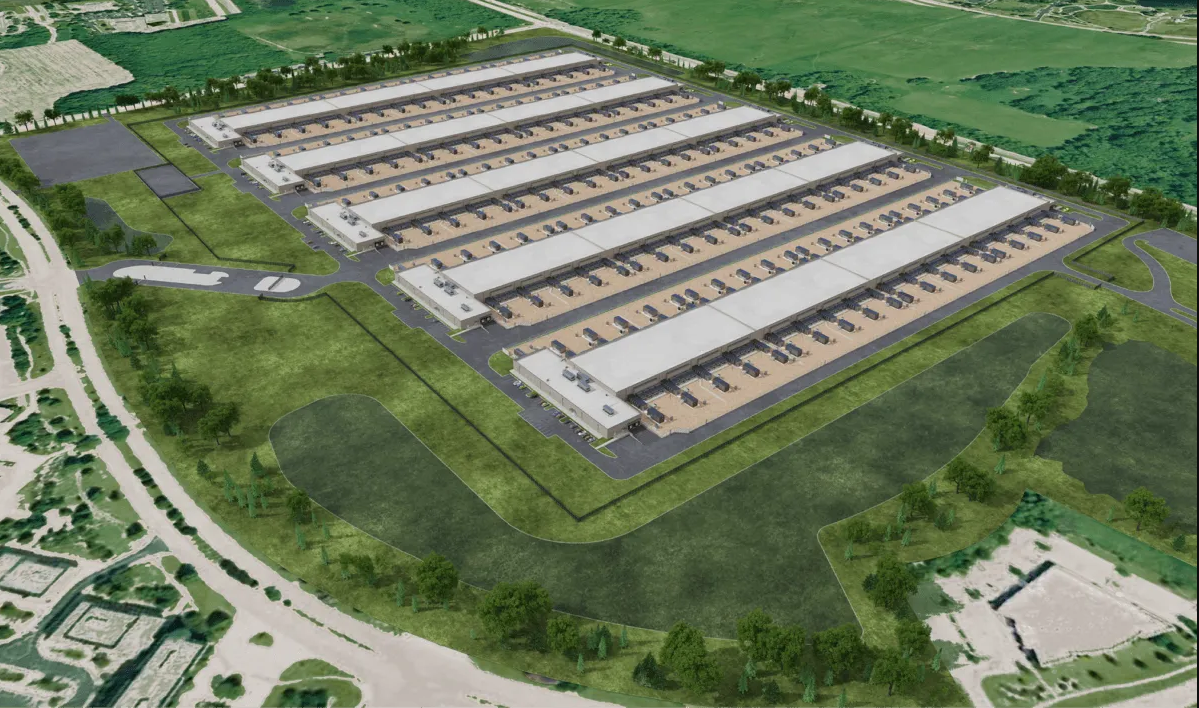
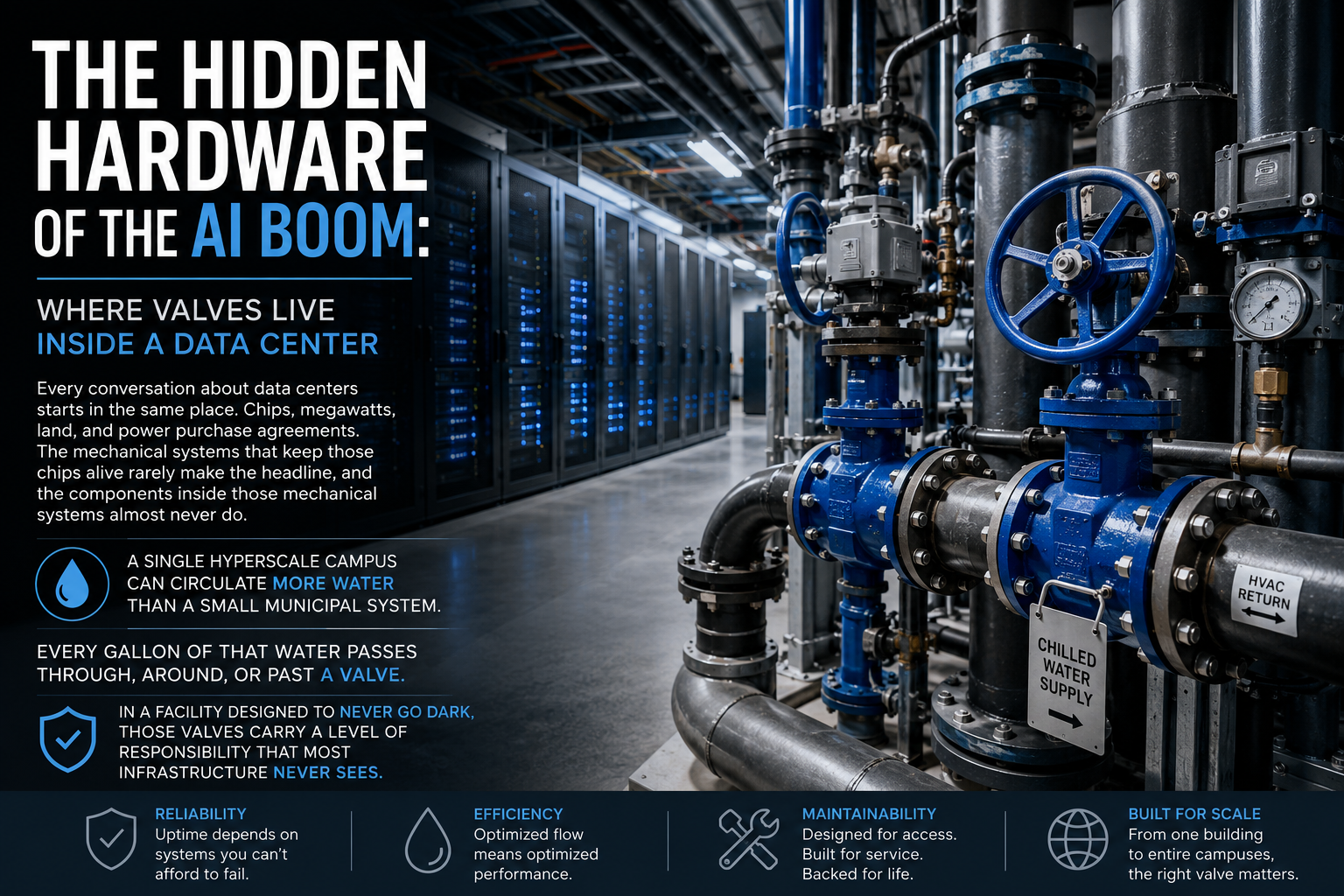
Here is why. The current wave of data center construction is really a water project. A single hyperscale campus can move more water than a small city system. Every gallon passes through a valve. In a building designed to never go dark, those valves carry serious responsibility.
This article maps the cooling system of a modern data center. It shows where the valves go, which types do what, and how a manufacturer earns a spot in the specification.
Why Cooling Defines the Data Center
A data center turns almost all of its power into heat. A 100 megawatt facility works like a 100 megawatt heater that never shuts off. Removing that heat is the core mechanical problem.
AI has raised the stakes. Older server racks drew 5 to 10 kilowatts. AI racks now pass 100 kilowatts, and new designs push beyond 200. Air cannot carry heat away at those densities. So the industry keeps moving water closer to the silicon.
More water near the racks means more pipe, more connections, and more valves. It also means less room for error. A leak in an office building is a maintenance call. A leak above a row of AI servers is a seven figure loss and an outage.
Data Center: The Cooling System, Piece by Piece
Most large data centers use the same building blocks. The details vary by climate and owner. The structure stays consistent.
Data Center: The Central Plant
The central plant is the heart of the operation. It holds chillers, pumps, heat exchangers, and controls. The plant produces chilled water, usually between 55 and 70 degrees, and sends it out to the data halls.
Redundancy shapes the whole layout. Owners design plants to N+1 or 2N standards. There is always a spare chiller and pump beyond the load. That spare capacity only works if crews can isolate any single unit, drain it, service it, and return it to duty while the rest of the plant runs.
Data Center: Cooling Towers and the Condenser Loop
The heat pulled from the data halls has to go somewhere. In water cooled plants, a condenser loop carries it out to cooling towers. The towers reject it to the air through evaporation.
Builders split towers into multiple cells. Operators can then pull one cell offline for cleaning or winter prep while the others keep running. Some owners now favor closed loop and air cooled designs to cut water use. Those designs save water but keep the internal loops. The water still circulates. The valves stay.
Data Center: The Distribution Network
Large mains leave the plant and branch into headers. Those headers feed each building, each hall, and each floor. On hyperscale sites, the mains can reach 48 inches in diameter.
Phased construction makes distribution tricky. Campuses grow in stages over years. The pipe installed on day one must accept branches for buildings that do not exist yet. Those tie-ins must happen live, without touching the halls already running. Designers plan the network from the start to be sectioned, isolated, and expanded in service.
Data Center: The White Space
Inside the halls, chilled water reaches the equipment closest to the servers. In air cooled halls, that means computer room air handlers, called CRAHs, or fan walls. Each unit connects to the loop with supply and return lines.
In liquid cooled halls, the water goes further. Coolant distribution units, called CDUs, link the building loop to a smaller loop that runs straight to cold plates on the processors. Rear door heat exchangers take another approach and mount water fed coils on the back of the rack.
This is the frontier. Direct to chip cooling is becoming standard for AI capacity. It multiplies the water connections inside the white space by ten or more.
Where Data Center Valves Actually Go
With the system in view, the valve map comes into focus. Here is the walk from plant to rack.
Data Center: Chiller and Pump Isolation
Every chiller carries isolation valves on its evaporator and condenser lines. Every pump carries them on suction and discharge. In big plants, these are almost always butterfly valves. They are compact, light for their size, and seal reliably.
The duty is specific. These valves may sit open for months. Then a technician needs them to seal drop tight to open a chiller or pull a pump. A valve that weeps turns a routine task into a drain down of a much larger section. In a mission critical building, that can mean weeks of scheduling before anyone approves the work.
Newer plants often specify high performance butterfly valves with offset discs and seats rated for repeated cycling. Resilient seated designs still cover most moderate pressure duty.
Check Valves at Every Pump
A check valve sits right after every pump discharge. It blocks reverse flow the moment a pump stops. Without it, backward flow can spin and damage the pump. Reverse flow through a parallel path also short circuits the loop.
Engineers pay close attention here because of check valve slam. When flow reverses faster than the valve closes, the disc slams shut. That slam sends a pressure spike hammering through the pipe. Silent and spring assisted designs close before reverse flow builds. In a plant where dozens of pumps cycle daily, slam is a real problem, not a textbook one.
Cooling Tower Cell Valves
Each tower cell gets isolation valves on supply and return, plus valves on the equalizer lines between cells. This water runs harsher than the chilled side. It sits open to the air, carries treatment chemicals, and picks up dust and debris.
Materials matter more here. Seats, disc coatings, and stem seals must handle the chemistry and the grit. In cold regions, these valves also drive freeze protection. Crews drain single cells for winter while the rest stay in service.
Balancing and Control Valves
The network also needs flow management, not just open and shut. Balancing valves at each branch make sure far loads get their design flow. Control valves at coils modulate flow with temperature. Pressure independent control valves now lead many specs because they hold design flow even when pressure swings elsewhere.
Some designs use triple duty valves that combine shutoff, check, and balancing at the pump. Many engineers now prefer separate components instead. Separate parts are easier to service and drop less pressure.
Riser and Sectional Isolation
Every floor takeoff, hall branch, and future stub gets an isolation valve. This quiet population makes phased construction possible. When a new hall ties into a live loop, one question decides everything. Did the original design place sectional valves in the right spots, and do they still seal after years open?
Some operators use hot tapping to add connections where no valve exists. Every one of them would rather have had the valve on day one. Valves that sit idle for years and then must perform on demand reward conservative specs. Proven seats, quality stem seals, and manufacturers with long track records win here.
The White Space and Liquid Cooling
At the CRAH level, smaller isolation valves sit on every unit, usually 2 to 6 inches, along with balancing and control valves. Multiply that across dozens of units per hall and dozens of halls per campus.
Liquid cooling adds a layer on top. CDUs carry isolation on both sides. Manifolds feeding a row of racks carry isolation at each branch. The rack level uses quick disconnects and small valves from the IT hardware world. The building side of every CDU still falls under the mechanical spec.
Liquid cooling will keep growing with AI density. Every point of growth adds valves to the building.
The Supporting Cast
A full count also includes air release valves at loop high points and drains at the low points. Relief valves protect equipment. Plug and ball valves run through the treatment, makeup, and blowdown systems. Out at the street, municipal style gate valves and meters guard the water service. Fire protection carries its own regulated valve population on top of all this.
None of these parts are exotic. All of them matter. A stuck air vent starves coils and hides capacity. A weeping drain wastes treated water around the clock. The best facilities specify the whole valve population with intent, not just the big plant valves.
How Valves Get Approved
For manufacturers, the path into a project runs through the specification. More and more, it runs through a document that sits above any single project. That document is the approved manufacturer list, or AML.
Large owners and their engineering firms keep basis of design documents and AMLs that standardize equipment across every project they build. Make the list, and your product qualifies for the whole program. Miss the list, and no amount of job site effort puts your valve in the pipe.
What Reviewers Look For
The review before approval runs deep, and it should. Reviewers typically weigh six things.
Proven history. Data center owners buy conservatively. Decades of documented service in water infrastructure or district cooling carry more weight than any datasheet.
Manufacturing consistency. A campus program may need thousands of identical valves over several years. Owners want proof that unit five thousand matches unit one.
Testing and standards. Compliance with AWWA, MSS, and API standards gives engineers an objective baseline. Documented factory testing backs it up.
Lead time. Hyperscale schedules forgive nothing. A great product that ships late creates risk the project team will not accept.
Parts and service. These buildings run for decades. Seat kits, spare discs, and responsive support matter to the teams who inherit them.
Local reps. Engineers and contractors favor manufacturers whose reps show up, answer submittal questions fast, and support commissioning.
The Takeaway for Engineers
Valve selection deserves the same scrutiny as chiller and pump selection. Valve failures show up far too often in the incidents that turn maintenance windows into outages. For manufacturers, the lesson is patience. The work of earning approval happens long before ground breaks, through testing, documentation, and relationships with the engineering community.
The Bottom Line
People tell the data center story as a computing story. Underneath it sits an older, quieter story about moving water. Produce it cold. Distribute it precisely. Isolate it safely. Do it all without interruption for decades.
Data center valves decide whether that story succeeds. Specify them well, and nobody ever thinks about them. Specify them poorly, and they become the reason a building that should never go down, went down.
AI keeps pushing densities higher and water closer to the chip. The valve count will keep climbing, and so will the cost of getting the spec wrong. The engineers, builders, and manufacturers who treat these parts as critical infrastructure are the ones the industry will keep calling back.
Related reading
More coverage on data center: Why Many High-Energy Manufacturers Are Still Sitting on the Sidelines of the Energy Transition and ⚡ Large-Scale Energy and the AI Boom: Why Scale, Storage & Co-Generation Are Defining the Future. For background from an outside source, visit the U.S. Environmental Protection Agency.
Get the Eco Business News newsletter. Free.
Plain news on eco, business and data centers. No spam.